
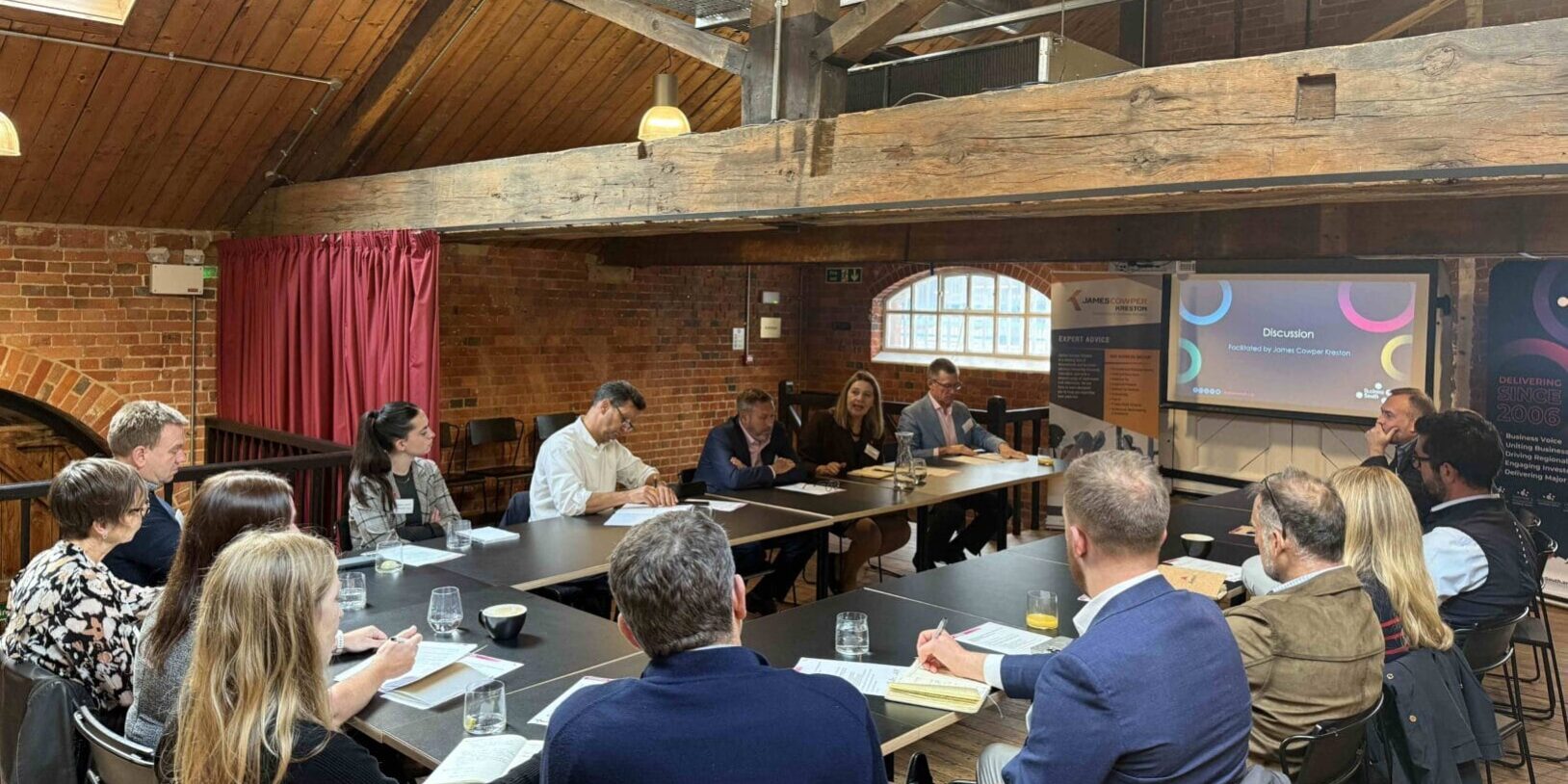
Following the Chancellor’s Autumn Budget, Business South and James Cowper Kreston brought together business leaders from across the South Coast to discuss its implications for businesses and the regional economy.
The Budget put growth, investment, housing and devolution firmly on the agenda. But what will those announcements mean in practice for businesses across the South?
While concerns over rising costs, housing delivery, energy infrastructure and devolution featured heavily throughout the discussion, there was also a strong sense that businesses remain ambitious about the future and determined to keep moving forward. The bigger question is what the South needs to turn that ambition into investment and growth.
Businesses want devolution to deliver
One of the first themes discussed was devolution and local government reorganisation. Participants broadly agreed that giving regions greater control over local priorities is positive, particularly when it comes to infrastructure, economic development and investment.
The Budget reinforced the Government’s commitment to greater regional decision-making, with Hampshire & the Solent specifically named among the areas at the forefront of its expanded devolution programme.
As one attendee observed: “Devolution is a good thing because it’s about local decision making and I think that the South needs some autonomy about what happens in the South.”
However, concerns were raised about delays to governance reforms and the postponement of the region’s mayoral elections. Several participants questioned whether the South risks falling behind other areas that already benefit from stronger devolved powers and access to funding.
One contributor captured the mood succinctly: “It feels like the handbrake’s a bit stuck. We’re part way there and it’s like, come on, we’re ready. Let’s go.”
Despite these frustrations, there was a strong belief that devolution remains an important opportunity, provided momentum is maintained and decisions can be made closer to the communities and businesses they affect.
Businesses need the confidence to invest
A recurring theme throughout the roundtable was the number of investment decisions being delayed.
From elections and inflation to global uncertainty and interest rates, businesses described a long list of reasons why projects have been postponed over recent years. Yet several attendees argued that continually waiting for greater certainty risks becoming a barrier in itself.
One participant offered a simple challenge: “If you’ve got a good project, do it.”
Across sectors there was recognition that significant demand still exists, particularly in development, infrastructure and commercial projects. The issue is often not a lack of opportunity, but having sufficient certainty to commit.
The Budget may have provided further incentives and capital to support investment, but the message from the room was that confidence will be just as important in turning those opportunities into action.
Housing needs viability, not just demand
Housing and development generated some of the strongest discussion of the day.
The Budget included a number of measures aimed at getting more people onto the housing ladder and supporting new development. The Government’s new £4.7 billion Your First Home scheme is expected to help around 70,000 first-time buyers while supporting the delivery of an estimated 20,000 new homes.
For the next generation looking to buy their first home, these measures could provide welcome support. But around the table, the question was whether they will be enough to overcome the viability challenges currently preventing new homes from being built in the first place.
As one attendee put it: “It’s a supply problem, not a demand problem.”
Participants spoke about increasing planning costs, lengthy approval processes and viability pressures preventing schemes from progressing. Several pointed out that developments may already have support and demand behind them but still struggle to move forward because of financial constraints.
One contributor noted: “There are a number of shovel-ready projects. The only problem is viability.”
The message was clear: achieving ambitions around housing requires tackling the planning, infrastructure and viability constraints preventing developments from being delivered, alongside measures to support buyers.
Growth needs the infrastructure to support it
The transition to renewable energy was another significant theme, particularly given the opportunities it presents across Hampshire and the wider South.
Examples were shared from anaerobic digestion projects, solar developments and rural energy schemes, with participants highlighting the growing role farmers and landowners can play in supporting the UK’s energy transition.
Yet despite strong interest from investors and developers, infrastructure continues to be a major constraint.
This is a challenge recognised in the Budget, which explicitly identified slow grid connections and energy costs as barriers to business growth. The Government said Great British Grid will work alongside network operators to support grid upgrades.
For businesses around the table, however, the impact of constrained grid capacity is already being felt.
As one participant remarked: “The grid connection is a killer.”
Several attendees described renewable energy projects with planning consent and commercial backing that remain stalled because of delays in securing network connections. Others pointed to the challenge of accommodating renewable generation on a network not originally designed for significant volumes of decentralised energy production.
The direction set out in the Budget was welcomed, but investment in energy generation needs to be matched by the infrastructure needed to support it. Otherwise, viable projects risk remaining stalled.
Employers need room to recruit and train
The cumulative impact of employment costs was another issue raised repeatedly throughout the discussion.
The Budget confirmed a 3.9% increase in both the National Living Wage and National Minimum Wage rates. Businesses discussed the combined effect of these increases alongside wider employment regulations, with concerns about what this could mean for recruitment and workforce development.
Particular concern was raised around opportunities for younger workers.
As one attendee observed: “A big worry is how are we going to train young people?”
Several employers noted that rising employment costs are increasing the risk associated with taking on entry-level staff, apprentices and trainees. Others said the pressures are accelerating investment in technology, automation and outsourcing.
One business leader commented: “We’ve moved to outsource certain parts of our process because we just cannot take the risk of employing the next ten people.”
While few disputed the importance of improving living standards, the concern was that the cumulative cost of employment could make businesses more reluctant to recruit and train the next generation, with longer-term implications for skills across the region.
The South needs to be louder about its strengths
Despite the challenges discussed, the overall mood was far from pessimistic.
The Budget’s ambition is to deliver what the Government describes as “good growth in every postcode”, with greater regional autonomy and investment intended to play a central role. The South already has many of the ingredients needed to capitalise on that ambition.
Participants pointed to its strengths, from ports and universities to advanced manufacturing, clean energy opportunities, professional services and development potential.
One contributor reflected on a recent visit to Manchester and the confidence with which the city promotes itself as a place to invest and do business. The comparison prompted discussion about whether the South does enough to champion its own strengths and opportunities.
As one attendee put it: “We’ve got to keep banging that drum.”
Perhaps that best captured the mood of the roundtable. South Coast businesses are not short of ambition, ideas or opportunities. What they need is for some of the barriers to be removed.
Faster progress on devolution, viable development, better energy infrastructure, greater certainty for investment and an environment in which businesses can continue to recruit and develop people would all help turn that ambition into long-term growth.
The Budget has set out the Government’s ambitions for growth. For businesses across the South, the challenge now is turning those ambitions into delivery.