
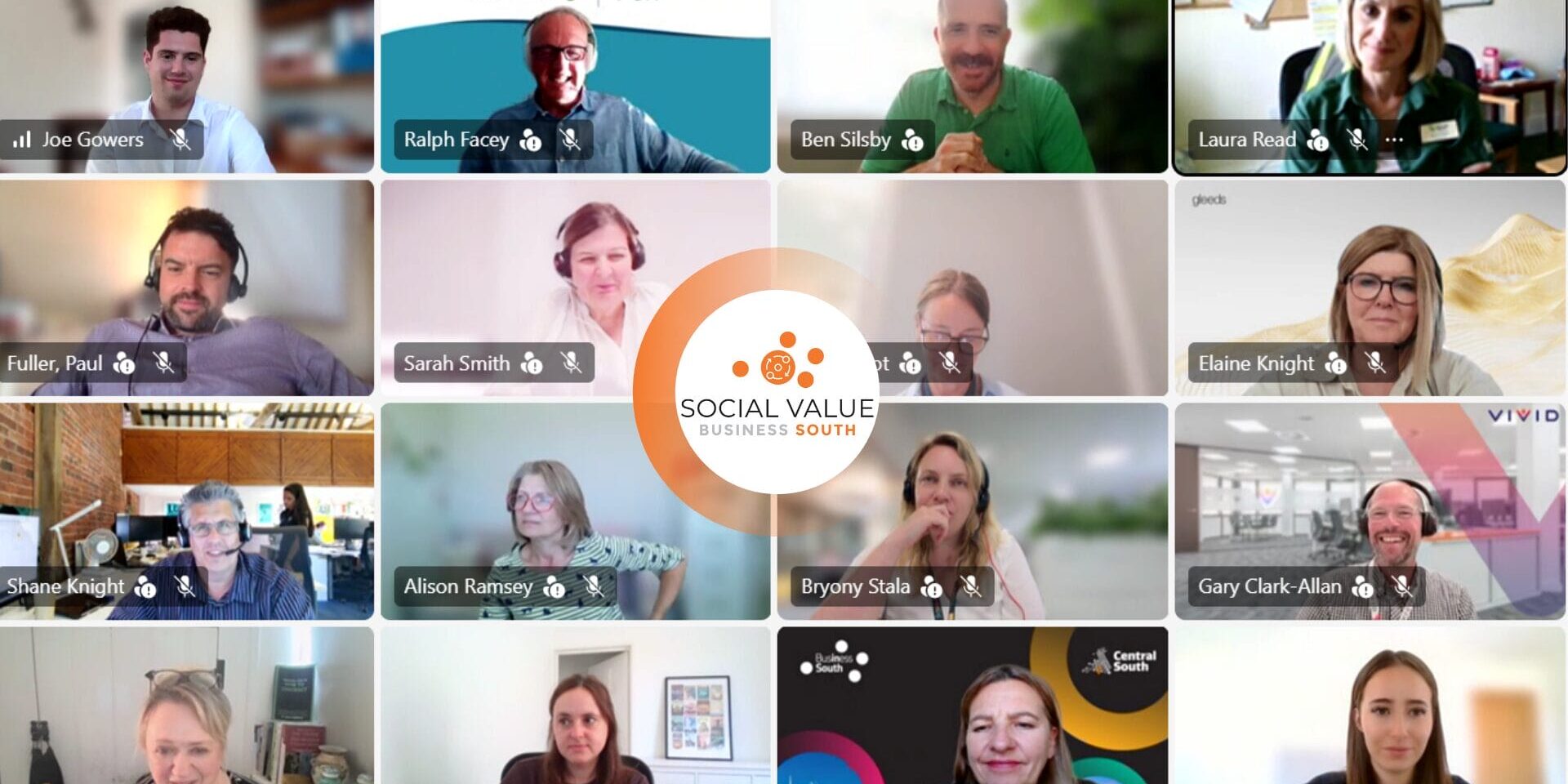
Business South’s Social Value Action Group explored how Business South Champions can better report, track and demonstrate the long-term impact of social value activity.
As the group continues to grow in membership, co-chairs Ben Silsby (Senior Sustainability Manager, Willmott Dixon) and Laura Read (CEO, Marwell Zoo) welcomed and introduced attendees, outlined the session’s key discussion on demonstrating social value in practice and using data to drive community engagement.
Our first presenter was Gurv Garcha (Senior Social Value Project Consultant, Ridge) who shared the organisation’s approach to embedding social value across the business through a framework built around four strategic pillars: Environmental Stewardship, Responsible Business, Equitable Economy and Resilient Communities.
The framework considers the social, economic and environmental value created through projects, people and supply chains, with initiatives ranging from carbon literacy training and climate action to skills development, inclusive recruitment, volunteering and community investment.
This approach has resulted in significant recent achievements, including supporting more than 80 apprenticeships and 80 work placements, alongside 187 employees completing social value training and continued commitments through the Care Leaver Covenant and the Armed Forces Covenant.
The group emphasised the importance of tailoring social value activity to local needs rather than relying on standardised programmes, and explored effective ways to use deprivation, employment and demographic data to target interventions.
We were also joined by Ralph Facey Managing (Managing Director of the Octavia Foundation) and Cita Jagot (Assistant Director of Community Investment) who outlined how Abri’s Octavia Foundation is using data to target investment where it can make the greatest difference.
Abri has mapped needs across its housing stock using external datasets, including the Index of Multiple Deprivation, health, crime and Active Lives data, alongside internal housing information. This evidence is being used to identify priority areas for community investment across the Central South.
Rather than applying a one-size-fits-all approach, the Foundation works with residents and local partners to co-design solutions, supporting initiatives focused on community wellbeing, financial resilience, employment and stronger local networks.
Abri’s new KPI framework will measure success through a combination of quantitative data and lived experience, recognising that meaningful impact cannot be captured by numbers alone.
Looking ahead, the Social Value Action Group aims to maximise its collective impact across the Central South. Members agreed to continue exploring opportunities to develop a regional needs analysis, improve impact reporting, share learning, and create a collaborative resource containing case studies, templates and practical guidance.
There was also strong support for mentoring SMEs and supply chain partners to help embed social value more consistently, alongside promoting successful projects that showcase the Central South as a centre of excellence for social value delivery.